Trans-axillary Breast Augmentation…what’s the confusion?
I am often surprised at what my patients tell me they read, hear or have been told about some of the more commonly performed cosmetic surgeries they are interested in. Breast augmentation is one of the usual ones cited as confusing by some of my patients, especially regarding the different incision types. Occasionally, patients report that some of the misinformation comes from other surgeons, even ones that I know are very experienced. This is often regarding one of the newer techniques used for breast augmentation… the transaxillary or armpit incision.
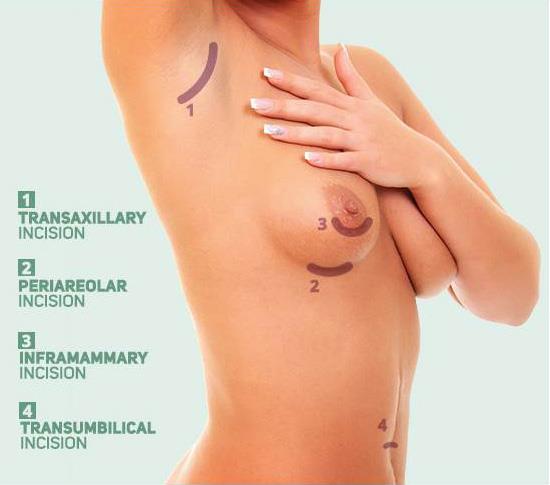
The truth about incisions to place breast implants is fairly simple. In most patients, if the surgeon is experienced in all types of incisions, the results should be similar regardless of the approach used. There are 6 different approaches possible to place breast implants commonly used today. They are…
Transaxillary
Periareolar
Inframammary
Trans-umbilical (limited to saline implants only)
Trans-abdominoplasty (through the tummy tuck incision)
Trans-mastopexy (through mastopexy or breast lift incisions
In my practice, the transaxillary, inframammary and trans-mastopexy incisions are by far the most common approaches requested. However, the transaxillary incision seems to be a source of some confusion for patients and surprisingly, some surgeons. I have been told by more than a few clients that they were informed that they could only get saline or very small silicone implants if they chose the armpit incision… or that there is a higher risk of asymmetry using the transaxillary technique. That is entirely untrue. I have personally placed large gel implants via the armpit approach and have had wonderful results with a very high rate of symmetry and patient satisfaction using this technique. For this reason this has become my most requested approach to breast augmentation. So why is it that this “myth” continues to be espoused.
Here are a few of my theories as to why…
Lack of any actual experience with this technique by some surgeons offering breast augmentation
Increased cost of materials required for the transaxillary technique (i.e. different retractors, and endoscopic instruments),
Lack of training in this particular technique in many residency programs, and
Overall, a higher degree of technical demand placed on the surgeon (the inframmamary and periareolar incisions are typically easiest to learn)
So what are the advantages of the transaxillary/armpit approach to breast augmentation? Primarily, it is that this format keeps an incision off the breast as long as possible. Of course, breast implants do not last a lifetime in most cases, so any replacement, adjustment or removal will require a different incision type. There are also several studies that suggests this incision type has a lower degree of complications versus others; specifically related to a higher chance of being able to nurse after breast augmentation, lower risk of infections and lower rates of capsular contracture.
To summarize, the armpit or transaxillary incision for breast augmentation is a wonderful option for most patients seeking breast enhancement and can be used to place both types of implants (saline or silicone), all sizes and in either plane (above or below the muscle). If you want to keep incisions off the breast as long as possible, this may be a great option for you. For more information on breast augmentation or other cosmetic procedures at McLain Surgical Arts please call 256.429.3411 or complete the online contact form on our website
Dr. McLain
“Do not hire a man who does your work for money, but him who does it for love of it. “
Cosmetic fillers have revolutionized the modern cosmetic surgery practice. And despite the ever increasing cultural acceptance to cosmetic enhancements and abundance of industry advertising and branding… still, many patients are confused about fillers and what they can and cannot do. As we age not only does gravity and sun damage affect the quality of our skin, but we lose volume in key areas of the face. Much like a grape becomes a raisin, volume loss significantly contributes to wrinkle formation.
Facial aging areas
Let me take a moment to clear the air and “fill you in” on the most common fillers used in my practice here at McLain Surgical Arts…
1. Hyaluronic Acid (HA) Fillers:
The most commonly HA fillers are Belotero, Juvederm, Restylane and Perlane. These types of fillers have been used in the US since 2004 and have a proven safety and performance record. Hyaluronic Acid (HA) is a normally occurring substance in the human body, primarily found in skin, joints and neural tissues. Interestingly, when skin is exposed to excessive UVB rays from the sun over time, the skin loses hyaluronic acid and begins to lose volume and vibrance. This results in premature aging. Fortunately, HA can be produced in a laboratory which nearly eliminates the potential for severe allergic reaction that was common to older collagen based fillers. Although very similar each of the types of HA fillers have specific differences based primarily on molecule size and/or the amount of crosslinking between the molecules. I personally prefer Restylane in the tear trough areas due to its ease of molding, while I prefer Juvederm in the lips because it seems to last longer.
2. Calcium Hydroxyapatite Fillers:
In 2006, the FDA approved calcium hydroxyapatite for cosmetic injection. This cosmetic filler is made of the minerals that give bone its strength and texture. These minerals are ground into tiny particles and suspended in an aquesous solution, which is injected under the skin. In the trial that led to its approval, calcium hydroxyapatite worked significantly better and lasted longer than collagen injections to reduce severe wrinkles. This filler is white and is best used at deeper levels of facial atrophy. Radiesse is my preferred filler for lower facial and cheek large volume replacement. It has perhaps the most natural result of any of the dermal fillers and has the added benefit of stimulating your skin to form its own collagen. It is not useful for lips and tear trough areas due to the need to place at very superficial levels in these areas.
Most popular facial dermal filler locations
3. Autologous Fat:
Fat grafting to fill soft tissue deficits has been around since at least the late 19th century and has gained increasing popularity in the past 20 years for facial and body volume restoration. The primary advantage of fat is that it is autologous and there is zero risk of transmittable disease or allergic reaction. It is considered semi-permanent because only a portion of the total fat grafted survives permanently, but with improvements in harvesting and application techniques one can expect about 50-60% of the transplanted fat to remain. In addition to volume restoration of the face, fat is very popular in treating body contour defects; the buttocks for example, otherwise known as a Brazilian buttock lift.
Hopefully this gives you a bit of information on the most popular fillers used here at McLain Surgical Arts. There are obviously other options, but these three forms have become the worhorses in reversing age related atrophy and wrinkles in my practice.
For more information on dermal fillers in Huntsville, Al, please visit us online or call 256.429.3411 for a complimentary consultation.
McLain Surgical Arts is pleased to launch our new blog. Here, we will keep our patients up to date on the latest news in cosmetic, oral and maxillofacial surgery. It will also be your go-to resource to learn about events and developments at our surgery center and med spa in Huntsville, AL.
Whether commenting on the happenings at his practice or on broader topics affecting the entire medical community, Dr. McLain will keep readers current on:
Advances in surgical techniques and equipment
Important issues concerning aesthetic medicine, dentistry and jaw surgery
Events and specials at our practice
Dr. McLain’s wide base of training and experience drives his comprehensive approach to surgery. This blog will allow us to share his unique perspective with you.
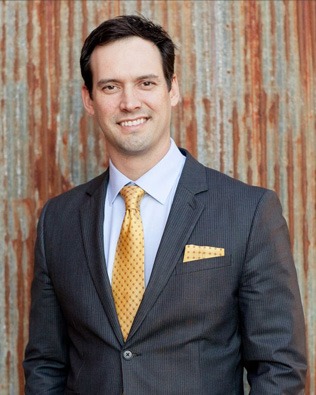
Landon McLain, M.D., D.M.D., F.A.A.C.S., is more than just a cosmetic surgeon, dentist or oral & maxillofacial surgeon. In fact, he has extensive training in all 3 disciplines, and the product is greater than the sum of its parts. This training informs every oral and cosmetic surgery procedure Dr. McLain performs in Huntsville, AL.
As a double-board-certified cosmetic and oral & maxillofacial surgeon, Dr. McLain has training that includes:
Medical and dental degrees
Residency training in oral & maxillofacial surgery with special emphasis on facial trauma, reconstruction and orthognathic (jaw) surgery
Fellowship training – the highest level of surgical training available – in cosmetic surgery
Dr. McLain’s cosmetic fellowship, among the nation’s most competitive of its kind, allowed him to complete an astounding 1,400 major surgical procedures. Oral & maxillofacial residency also presented him with significant experience in facial cosmetic surgery. His level of training in these separate but related disciplines puts him in a class by himself among surgeons in his region.
What does this all mean you when you choose Dr. McLain? It means you’re getting a uniquely qualified surgeon whose wide range of training allows him to address facial trauma, oral conditions and cosmetic needs simultaneously. It means he’ll consider aesthetics when addressing anatomical function, for example, and vice versa. Dr. McLain’s depth of experience and technical skill also produces optimal results from his breast and body procedures.
When you choose Dr. McLain, you’re choosing a surgeon with proven dedication to advanced, comprehensive training and patient-focused care – necessities for ensuring safe, long-lasting results.

 I am often surprised at what my patients tell me they read, hear or have been told about some of the more commonly performed cosmetic surgeries they are interested in. Breast augmentation is one of the usual ones cited as confusing by some of my patients, especially regarding the different incision types. Occasionally, patients report that some of the misinformation comes from other surgeons, even ones that I know are very experienced. This is often regarding one of the newer techniques used for breast augmentation… the transaxillary or armpit incision.

 McLain Surgical Arts is pleased to launch our new blog. Here, we will keep our patients up to date on the latest news in cosmetic, oral and maxillofacial surgery. It will also be your go-to resource to learn about events and developments at our surgery center and med spa in Huntsville, AL.